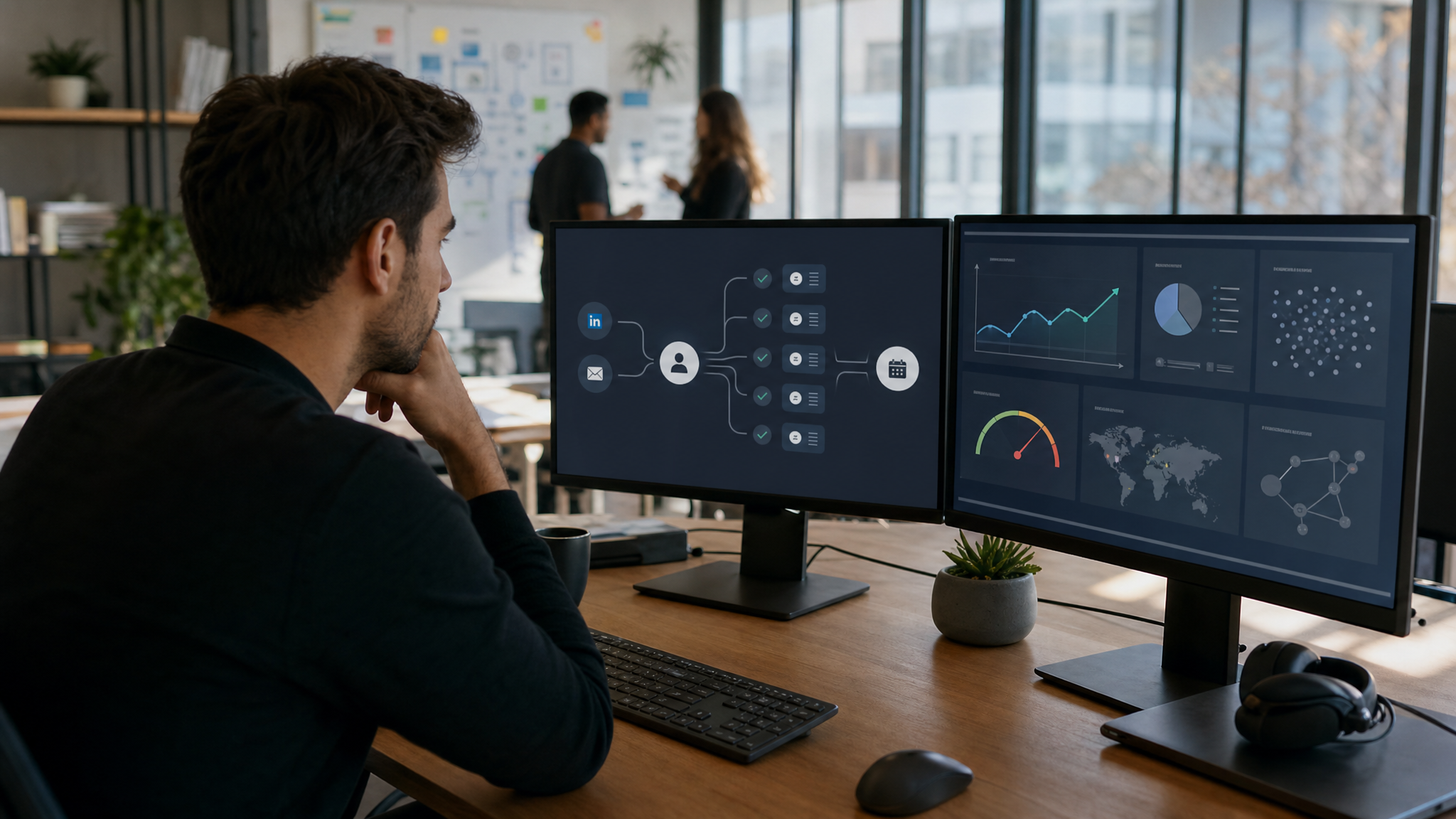
Every high-performing outbound motion runs on one core principle. You need to know exactly who you're selling to. You also need to know how they buy. Get that wrong and no amount of tooling or messaging fixes your conversion problem.
B2B stands for business-to-business. It describes how companies sell products and services to other companies — not to individual consumers. This model powers SaaS platforms, enterprise software, staffing firms, and logistics providers. It drives virtually every outbound sales team running sequences today. Understanding B2B isn't academic — it's operational.
This guide breaks down the B2B meaning in full. It covers the core definition, the four types of B2B business models, and real-world examples across industries. It also explains how a precise understanding of B2B translates into a more targeted, higher-converting outbound revenue system.
What Does B2B Mean? The Core Definition
B2B stands for business-to-business. It describes transactions, relationships, and sales processes conducted between two companies \[SOURCE\_4]. It does not include sales to individual consumers.
Here are three clear examples. When a SaaS platform sells a CRM subscription to a 200-person sales team, that's B2B. When an industrial equipment manufacturer sells conveyor systems to an automotive plant, that's B2B. When a staffing agency places engineers inside a Series B startup, that's B2B.
The B2B model spans every major industry. This includes software, manufacturing, professional services, logistics, healthcare infrastructure, financial services, and recruiting. What unifies them is one shared dynamic. The buyer is an organization — not a person acting on personal preference.
In informal business contexts, B2B is also used as shorthand slang. When someone says "that's a B2B play," they mean the company targets business buyers. Business buyers include companies, teams, and procurement departments — not individual consumers. For SDRs, founders, and VPs of Sales, this is the only B2B meaning that drives revenue.
Why does the distinction matter? Because B2B buying decisions are complex. They involve buying committees, multi-stage procurement processes, and multi-touch outreach sequences. A buying committee is a group of stakeholders who all influence the purchase decision. These are not impulse purchases. Moving a B2B prospect from cold to closed-won requires a completely different infrastructure than consumer marketing.
B2B vs B2C: Key Structural Differences
The gap between B2B and B2C is not a matter of degree \[SOURCE\_2]. They are fundamentally different commercial models.
Decision-making unit: B2B deals involve an average of 6-10 stakeholders \[SOURCE\_5]. These include economic buyers, technical evaluators, champions, and procurement gatekeepers. B2C decisions involve a single consumer.
Sales cycle length: B2B deals average weeks to months depending on contract value. B2C purchases are completed in minutes to days.
Contract value: B2B deals carry higher annual contract values, also called ACV. ACV is the average yearly revenue from a single customer contract. Higher ACV justifies more touchpoints. A single enterprise contract can justify 15 or more outreach attempts across multiple channels.
Outreach strategy: B2B demands precise targeting. You target by job title, company size, industry, and buying stage. This is the same logic that powers effective cold outbound. Mass-market B2C channels don't translate to B2B.
B2B vs B2G and Other Variations
B2B is not the only business-facing commercial model. B2G stands for business-to-government. It involves selling to public sector entities. These buyers operate under procurement compliance frameworks, RFP requirements, and multi-quarter decision timelines. An RFP, or request for proposal, is a formal document a buyer uses to solicit bids from vendors.
B2B2C describes companies that sell through a business partner to reach the end consumer. This is common in SaaS channel distribution. D2C, or direct-to-consumer, describes manufacturers who bypass traditional retail and sell directly to end users.
These distinctions matter for outbound targeting. Your ICP definition — your ideal customer profile — determines your entire outreach infrastructure. ICP is a description of the company most likely to buy from you. A B2G motion requires a different sequence strategy than a B2B SaaS motion targeting VP-level buyers at growth-stage companies.
The 4 Types of B2B Business Models
Not all B2B companies sell the same way. Not all of them sell to the same buyers. Understanding the four core B2B model types sharpens your ICP definition. It also informs sequence personalization and aligns outreach triggers with real buyer behavior. Misidentifying your B2B type leads to misaligned messaging and wasted outbound capacity.
1. Producers (Manufacturers Selling to Other Businesses)
Producers manufacture raw materials, components, or finished goods. They sell directly to other businesses — not to consumers. Examples include industrial equipment suppliers and semiconductor manufacturers selling chips to device makers. SaaS infrastructure providers selling cloud compute and API access to development teams also fit this model.
For producer-type B2B companies, procurement cycles are long. Technical buyers evaluate specifications carefully. ROI-focused messaging is non-negotiable. ROI stands for return on investment — the financial benefit a buyer expects from a purchase. Sequences need to account for extended nurture windows and multiple stakeholder personas within a single account.
2. Resellers (Distributors and Wholesalers)
Resellers purchase products from producers. Then they redistribute them to other businesses or retailers. They add value through margin, logistics, or service. Value-added resellers — also called VARs — IT distributors, and staffing agencies all operate this way.
Reseller B2B is volume-driven and relationship-heavy. Cadence consistency and automated follow-up are the primary pipeline drivers. The buying decision often hinges on timing and relationship proximity. It rarely requires complex technical evaluation. Reps who follow up consistently win over reps who follow up sporadically.
3. Governments and Institutions
Public sector and institutional buyers include municipalities, hospitals, and universities. They operate under B2B purchasing frameworks with extended procurement timelines. Their processes are often RFP-driven and subject to compliance requirements.
Cold outreach to government buyers produces low ROI without deep personalization. Trigger-based sequencing helps. Knowing when budget cycles open is critical. Aligning outreach timing to fiscal-year windows is often the difference between getting into an RFP process and being ignored entirely.
4. Non-Profits and Associations
NGOs, foundations, and professional associations purchase software and services at scale. Their budget cycles differ significantly from commercial B2B. Fiscal-year awareness and timing are critical. Outreach that lands in the wrong budget quarter rarely converts — regardless of message quality.
This is an often-overlooked ICP segment for SaaS and services companies. Non-profits with 50 or more staff have real software budgets. They have compliance needs and operational pain points identical to commercial buyers. They are simply underserved by outbound teams that haven't mapped the segment.
B2B Sales: How the Business-to-Business Revenue Engine Works
B2B sales is the process of moving another company from unaware to closed-won through a defined pipeline \[SOURCE\_5]. Core stages include prospecting, outreach, discovery, demo, proposal, negotiation, and close. These stages sound simple in sequence. They compound in complexity when multiplied across hundreds of active accounts.
The modern B2B sales motion is multi-channel. LinkedIn, email, and phone must be coordinated across the full pipeline. Research consistently shows that B2B deals require 8-12 touchpoints before a meeting is booked \[SOURCE\_3]. Single-channel outreach leaves 60-70% of pipeline untouched. The prospect may be interested. The sequence just didn't reach them on the right channel at the right moment.
The shift from manual SDR workflows to autonomous outbound infrastructure is redefining what's achievable per rep. Teams that have made this shift report consistent pipeline generation at a fraction of the manual overhead.
The B2B Sales Funnel: From Cold Prospect to Booked Meeting
Top of funnel: This stage covers ICP identification, list building, and channel selection. The quality of your input data sets the ceiling on conversion. Poor lists produce poor pipeline — regardless of sequence quality.
Middle of funnel: This is the execution layer. It includes multi-touch sequences, objection handling, and follow-up cadences. Most teams leak revenue here. Manual follow-up breaks down under volume. Sequences go stale. LinkedIn touchpoints fall out of sync with email cadences. The infrastructure gap is most visible at this stage.
Bottom of funnel: This stage covers meeting confirmation, CRM sync, and handoff to account executives. Speed of follow-up after a positive signal matters. A reply, a profile view, or a content engagement are all positive signals. Most B2B sales teams run 3-5 disconnected tools to cover this funnel. That creates data silos and manual overhead that slow every stage.
B2B Sales Cycles vs B2C: Why Complexity Demands Automation
Every new stakeholder added to a B2B deal extends the sequence requirement. A deal that starts with one champion often escalates to include a VP, a procurement manager, and a legal reviewer. Each person requires tailored outreach at different timing. Manual follow-up management at this scale is the number-one source of pipeline leakage in outbound-led B2B teams.
Autonomous sequence management handles this complexity automatically. The system escalates channels, handles objections, and books meetings without rep intervention. Autonomous means the system acts without a human directing each step. This is not a marginal improvement. It's a structural shift in what a single SDR or founder can execute.
B2B Marketing: Reaching Business Buyers at Scale
B2B marketing focuses on generating awareness, demand, and pipeline among professional buyers \[SOURCE\_1]. Core channels include LinkedIn (organic and paid), cold email, content marketing, SEO, events, and partner referrals. The most effective B2B marketing in 2026 integrates demand generation with outbound activation. Content attracts. Sequences convert.
ICP-precision is the multiplier. Broad B2B marketing wastes budget on audiences that won't convert. Account-based approaches concentrate resources on the highest-probability buyers. Key metrics that actually matter include MQL-to-SQL conversion rate, cost per meeting, pipeline generated per channel, and sequence reply rate. MQL stands for marketing qualified lead. SQL stands for sales qualified lead. Vanity metrics like impressions and follower counts tell you nothing about revenue impact.
LinkedIn as a B2B Marketing and Outreach Channel
LinkedIn is the highest-signal B2B channel available. Job titles, company data, tenure signals, and hiring activity are native to the platform. This makes it the most precise targeting environment for outbound teams. InMail reply rates average 18-25% when messages are highly personalized \[SOURCE\_3]. Generic blasts average only 3-5%.
LinkedIn outreach combined with email sequencing produces 2-3x the meeting conversion rate of either channel alone. The infrastructure challenge is real. Managing LinkedIn touchpoints alongside email sequences manually creates inconsistency. It also creates compliance risk and data gaps. Reps switch between platforms, lose track of follow-up timing, and miss the compounding conversion effect that synchronized multi-channel sequencing delivers.
Cold Email in B2B: Deliverability, Personalization, and Scale
Cold email remains the highest-ROI outbound channel in B2B when deliverability is protected and personalization is systematic \[SOURCE\_5]. Deliverability is an infrastructure problem. Domain warming, sending volume limits, and mailbox rotation all determine whether emails land in the inbox or the spam folder. One burned domain can collapse an entire outbound program overnight. Rebuilding sender reputation takes weeks.
Personalization at scale requires dynamic variable systems — not manual copywriting for every prospect. Dynamic variables are placeholders that auto-fill with prospect-specific details like name, company, or job title. The teams generating consistent pipeline aren't writing better individual emails. They're running systems that produce personalized, deliverable email at volume without exposing domain health.
B2B Examples: What Business-to-Business Looks Like in Practice
Concrete examples make the B2B definition operational rather than theoretical. The buyer relationship, sales motion, and outreach dynamics differ across verticals. Understanding the pattern in each one sharpens both ICP definition and sequence design.
B2B SaaS Examples
CRM platforms sell workflow infrastructure to sales teams. Marketing automation tools sell demand generation systems to marketing departments. Outbound sales automation platforms sell autonomous pipeline generation to revenue teams.
The common thread across B2B SaaS is consistent. These companies use subscription models and multi-stakeholder sales processes. They place heavy emphasis on ROI demonstration during the sales cycle. The buyer isn't just evaluating the product. They're evaluating whether the investment is justifiable to a CFO or VP who wasn't in the demo.
B2B Services and Professional Services Examples
Recruiting and staffing agencies place talent inside companies. The agency sells access to a talent pool that the client can't efficiently build themselves. Management consulting firms sell strategic advisory to enterprise leadership teams. Digital agencies sell performance marketing services to B2B SaaS companies trying to scale pipeline.
These businesses are relationship-led. But first meetings are still initiated through cold outreach sequences. The sequence books the call. The relationship closes the deal. Assuming relationship-building can happen without a systematic outbound motion is how professional services firms stall at referral-only growth.
B2B in Recruiting: Heads of Talent as B2B Operators
Recruiting teams sourcing candidates from LinkedIn operate a B2B-adjacent outreach motion. The mechanics are identical to sales outreach. They involve high-volume sequencing, reply rate optimization, follow-up cadence management, and conversion tracking from initial message to scheduled call.
Heads of Talent running high-volume sourcing face the same infrastructure challenges as SDR teams. These include tool fragmentation, manual follow-up, and poor InMail response rates. The same autonomous outreach infrastructure that books sales meetings can be reconfigured to fill candidate pipelines. If you're managing a recruiting function with manual workflows, the infrastructure gap is costing you time-to-hire and candidate quality.
Common B2B Slang and Informal Usage
Outside formal business contexts, B2B appears in informal usage across several unrelated domains. Understanding the distinction matters for avoiding confusion.
In business contexts, B2B is informal shorthand for any commercial vendor relationship. "That's a B2B play" signals a go-to-market motion targeting business buyers. "We're building B2B infrastructure" means the product sells to companies, not consumers. This shorthand is universal among founders, SDRs, and VPs operating in commercial markets.
In music and DJ culture, B2B stands for "back-to-back." Two DJs share a set and alternate tracks in a collaborative performance. This usage has no connection to the commercial definition. It appears frequently in rave, festival, and electronic music contexts. Learn more about Insights - ReachLynk. For more insights, visit Reachlynk.
In dating and social contexts, B2B appears in colloquial slang with meanings entirely disconnected from business commerce. Context determines meaning entirely. If you encountered B2B in a non-business conversation, the commercial definition does not apply. You might also find Insights - ReachLynk helpful.
For sales professionals, SDRs, and founders: the only B2B meaning that drives revenue is the business-to-business commercial model. Every other usage is noise. You might also find ReachLynk - Autonomous LinkedIn & Email Outbound Infrastructure helpful.
How B2B Outbound Has Evolved: From Manual to Autonomous Infrastructure
The traditional B2B outbound model was entirely manual. SDRs prospected lists by hand. They wrote individual emails, tracked follow-ups in spreadsheets, and switched between LinkedIn and email tabs throughout the day. This created a measurable infrastructure gap. Follow-up cadences were inconsistent. Sending volume was unmanaged. LinkedIn outreach ran independently of email sequences. This produced duplicate touches and missed escalation opportunities.
Forward-deployed revenue teams are replacing this point-solution stack. They use unified outbound infrastructure that orchestrates LinkedIn and email in a single automated system. The outcome is concrete. Teams running autonomous outbound infrastructure report cost-per-meeting reductions of 40%. They generate consistent pipeline without scaling headcount proportionally.
The competitive advantage in B2B markets in 2026 is no longer access to prospect data. Data is a commodity. The advantage is the speed and precision of the system that converts data into booked meetings. AI-driven sequence optimization — including epsilon-greedy bandit logic for message variant testing — means the system improves conversion rates automatically. Epsilon-greedy bandit logic is a method that automatically allocates more outreach to whichever message variant is performing best. The sequence gets smarter as it runs.
The Infrastructure Stack Modern B2B Teams Are Building
The highest-performing B2B outbound stacks share a common architecture.
Unified LinkedIn + email sequencing eliminates tool-switching and data fragmentation. Every touchpoint flows through a single orchestration layer. This includes connection requests, InMails, follow-up emails, and reply handling.
Bi-directional CRM sync ensures every touchpoint is logged without manual data entry. CRM stands for customer relationship management — the software teams use to track prospects and deals. The sales team works the pipeline. The infrastructure handles the record-keeping.
AI objection handling responds to prospect replies and moves the conversation toward a booked meeting without rep involvement. Common objections around timing, budget, and authority are handled at the system level. The system escalates to a rep only when a human conversation is genuinely required.
Automatic channel escalation means if a LinkedIn connection request goes unanswered after a defined window, the system triggers an email sequence without a manual handoff. No touchpoint falls through the gap.
Email deliverability protection through API rate limiting, domain rotation, and sending schedule optimization keeps sender reputation intact at scale. This is the infrastructure layer that most teams don't build until after a domain is already burned.
If your current stack requires a rep to manually manage any of these functions, you're not running outbound infrastructure. You're running a manual process with software labels attached. If you're ready to see what autonomous outbound infrastructure looks like in practice, Book a Demo and see the full system running against a real ICP.
The Bottom Line
B2B — business-to-business — is the commercial model defining how companies sell to other companies. It spans four core types: producers, resellers, governments, and institutions. It covers every major industry vertical.
For SDRs, VPs of Sales, Heads of Talent, and founders running outbound, understanding B2B is not academic. It's the foundation of ICP definition, sequence strategy, and pipeline architecture.
B2B buying committees have grown more complex. Sales cycles have lengthened. The number of touchpoints required to book a meeting has increased. Meanwhile, rep capacity and manual bandwidth have stayed flat. The teams winning in B2B markets in 2026 aren't just better at sales. They've built better outbound infrastructure — unified, automated, and self-optimizing across every channel.
Precision on who you're selling to is the starting point. The infrastructure that executes on that precision at scale is what converts market opportunity into booked meetings. See how autonomous outbound infrastructure closes that gap — and why teams running it see cost-per-meeting drop 40% without adding headcount.
Frequently Asked Questions
Q: What is B2B slang for?
In business slang, B2B is shorthand for "business-to-business." When professionals say "that's a B2B play" or "we run a pure B2B shop," they mean the company sells to other businesses. It does not sell to individual consumers. This shorthand is widely used by founders, sales reps, marketers, and investors. It quickly communicates a company's go-to-market model. In outbound sales contexts, saying a team is "doing B2B" signals they target corporate buyers, procurement teams, or department heads — not retail customers. It's one of the most universally understood abbreviations in the business world.
Q: What does B2B mean in dating?
In dating and relationships, B2B does not carry the business-to-business meaning. In casual slang, B2B sometimes means "back to back." This refers to consecutive dates or romantic engagements happening one after another. However, this usage is informal and not standardized. It is important not to confuse this with the primary B2B meaning in business. In commerce, B2B strictly refers to transactions between two companies. If you've encountered B2B in a dating app or conversation, context usually clarifies the meaning. It may mean "back to back" or something entirely specific to that conversation.
Q: What does B2B mean at a rave?
At raves and in electronic music culture, B2B stands for "back to back" — not business-to-business. A B2B set at a rave means two DJs are performing together at the same time. They take turns playing tracks and feed off each other's energy in real time. For example, a festival lineup might advertise "DJ A B2B DJ B." That signals fans will get a collaborative live set from both artists. This is one of the most anticipated formats in electronic music. It creates an unpredictable, high-energy performance. This usage of B2B is completely separate from the business meaning. Context always determines which definition applies.
Q: What are the 4 types of B2B?
The four main types of B2B business models are: (1) Producers — companies that manufacture raw materials or finished products and sell them to other businesses, such as industrial equipment manufacturers selling to automotive plants. (2) Resellers — businesses that purchase products from producers or wholesalers and resell them to other companies without significant modification, like distributors and wholesalers. (3) Governments — public sector entities that purchase goods and services from businesses at scale, often through formal procurement and tendering processes. (4) Institutions — non-profit organizations, hospitals, universities, and similar entities that buy from businesses to operate their services. Understanding these four B2B types is critical for SDRs and sales teams. Each segment has different buying processes, decision-making structures, and procurement cycles that require tailored outbound strategies.
Q: What does B2B mean from a girl?
If someone uses the term B2B in a text or conversation, it most commonly means one of two things. The meaning depends on context — not on the gender of the person using it. In a professional or business setting, B2B means business-to-business. It refers to companies selling to other companies. In casual texting or social media contexts, it may mean "back to back." That indicates consecutive events, plans, or messages. If a girl texts you "I have B2B meetings today," she means back-to-back meetings. If she's in a business context, she may be referencing the business-to-business model. Context is always the key to interpreting B2B correctly.
Q: What is a B2B in dating slang?
In dating slang, B2B most commonly stands for "back to back" rather than business-to-business. It typically describes going on consecutive dates or having plans lined up one after another. For example, someone might say they had "B2B dates this weekend," meaning they went on multiple dates in rapid succession. This informal usage is popular in casual conversation and on some dating platforms. It is worth noting that this is entirely different from the standard B2B meaning in commerce. In business, B2B describes transactions between two companies. As with most abbreviations, understanding B2B correctly always depends on the context in which it appears.
Q: What is B2B in business and why does it matter?
B2B, or business-to-business, refers to any commercial transaction, relationship, or sales process conducted between two companies. It does not include sales to individual consumers. The B2B meaning is foundational to understanding how the majority of global commerce operates. It encompasses SaaS platforms, enterprise software, manufacturing, logistics, staffing, professional services, and more.
It matters operationally because B2B buying decisions are structurally complex. They involve multiple stakeholders — often 6-10 per deal. They require longer sales cycles measured in weeks or months. They involve formal procurement processes and multi-touch outbound sequences. For sales teams, founders, and marketers, a precise understanding of the B2B model directly informs how they build pipeline, structure messaging, and design outreach strategies that actually convert.